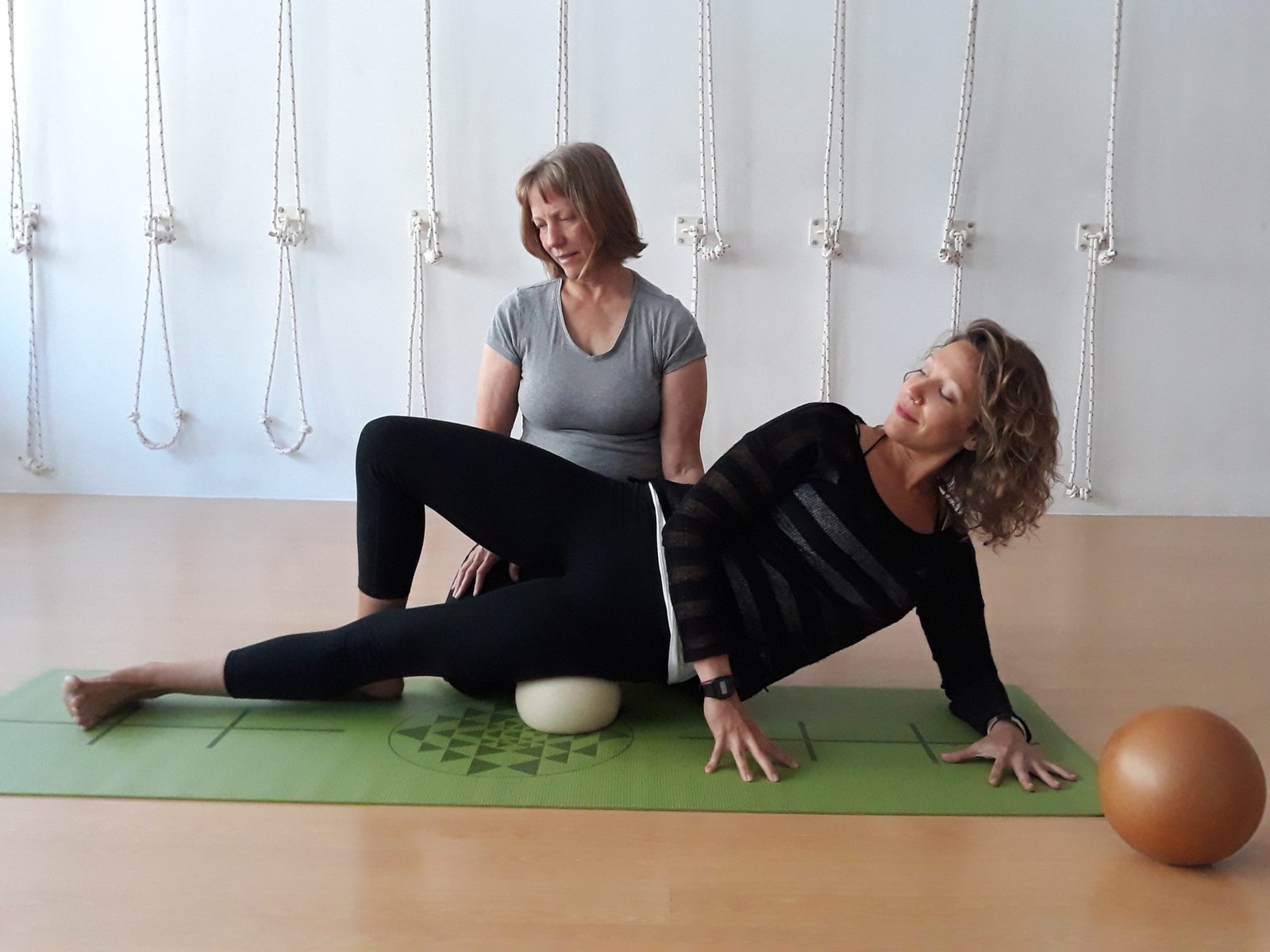
What connects wellbeing, posture, breathing, our perceptions and the freedom to choose how we respond? At Karmuka Yoga, we explore this question through practice and research. This perspective informs our
yoga classes and courses in San Luis Potosí and online,
as well as our teacher training.
Yoga and Trauma: Body, Brain and Freedom to Respond
The more I practice, the more I understand that the work of Yoga Asana has very little to do with achieving a posture. A posture can become a small space for learning: a place to observe how I respond to effort, uncertainty, my expectations and my own limits.

There are days when I feel unsteady, tense or disconnected. The practice invites me to recognize how that experience expresses itself in the support of my feet, the rhythm of my breathing and the way I move. Before trying to change what I feel, I can learn to listen to it.
Teachers, texts and the structure of yoga can guide us, but no one can feel on our behalf. This personal participation does not mean we have to do everything alone: support and trusting relationships are also part of learning.
The deeper work of yoga begins when we stop comparing and judging and learn to listen.
What Is Yoga?
Yoga uses the body, breathing and attention as pathways for exploring human experience. From the philosophical perspective of the
five koshas and the eight limbs of yoga,
the physical, energetic and mental dimensions, together with our capacity for discernment, are interconnected aspects of the same experience.
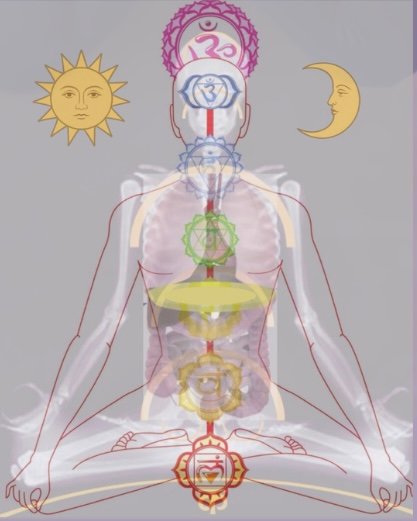

The physical body, or Annamaya Kosha, offers a tangible entry point into less tangible layers, such as breathing and its relationship with
the endocrine system and the energetic chakra system.
We can observe where we place our weight, which muscles are working or how our breathing changes. This observation also allows us to recognize patterns of attention, thoughts and emotional responses.
In this sense, the body is not an obstacle for the mind to dominate. It is a source of information and an active part of how we perceive the world.
Hatha Yoga: Body and Breath in Yoga Practice
Hatha Yoga uses the body and breath to observe and guide the mind, giving concrete expression to yoga’s path of self-knowledge and transformation.
Its meaning extends beyond a school such as Sivananda or a studio class labeled “Hatha.” Styles such as Iyengar, Ashtanga Vinyasa, Vinyasa and Sivananda develop this physical and breathing practice through different methods and emphases.
Tantric Roots and the Hatha Yoga Pradipika
Hatha Yoga has deep tantric roots, alongside ascetic influences. The Amṛtasiddhi, an eleventh-century tantric Buddhist text, already linked bodily actions, breathing and internal processes. Later, Svātmārāma brought earlier teachings together in the Hatha Yoga Pradipika, one of this tradition’s foundational manuals.
This manual describes postures, breathing practices and breath retentions, cleansing techniques, mudras and bandhas intended to transform inner experience and prepare for meditation. Physical work serves a purpose beyond strength or flexibility.
From this perspective, which we integrate into Karmuka Yoga, the body is recognized and celebrated as a means of knowing, as we explore in the article on
the five koshas and the eight limbs of yoga.
Body, Brain, Breath and Mind: Contemporary Research
This connection is explored in the
doctoral thesis of Dr. Michelle Goodrick, founder of the Karmuka Yoga Method,
which documented significant changes in prefrontal cortex activity and connectivity during and after a 23-minute practice, as well as improvements in postural alignment, changes in the brain’s response to breathing tasks and greater self-reported psychological wellbeing following a 30-day program. These findings provide evidence that physical practice can be accompanied by changes in the brain and psychological experience, both immediately and over a sustained period of practice.
Ha and Tha: An Interpretation of Balance
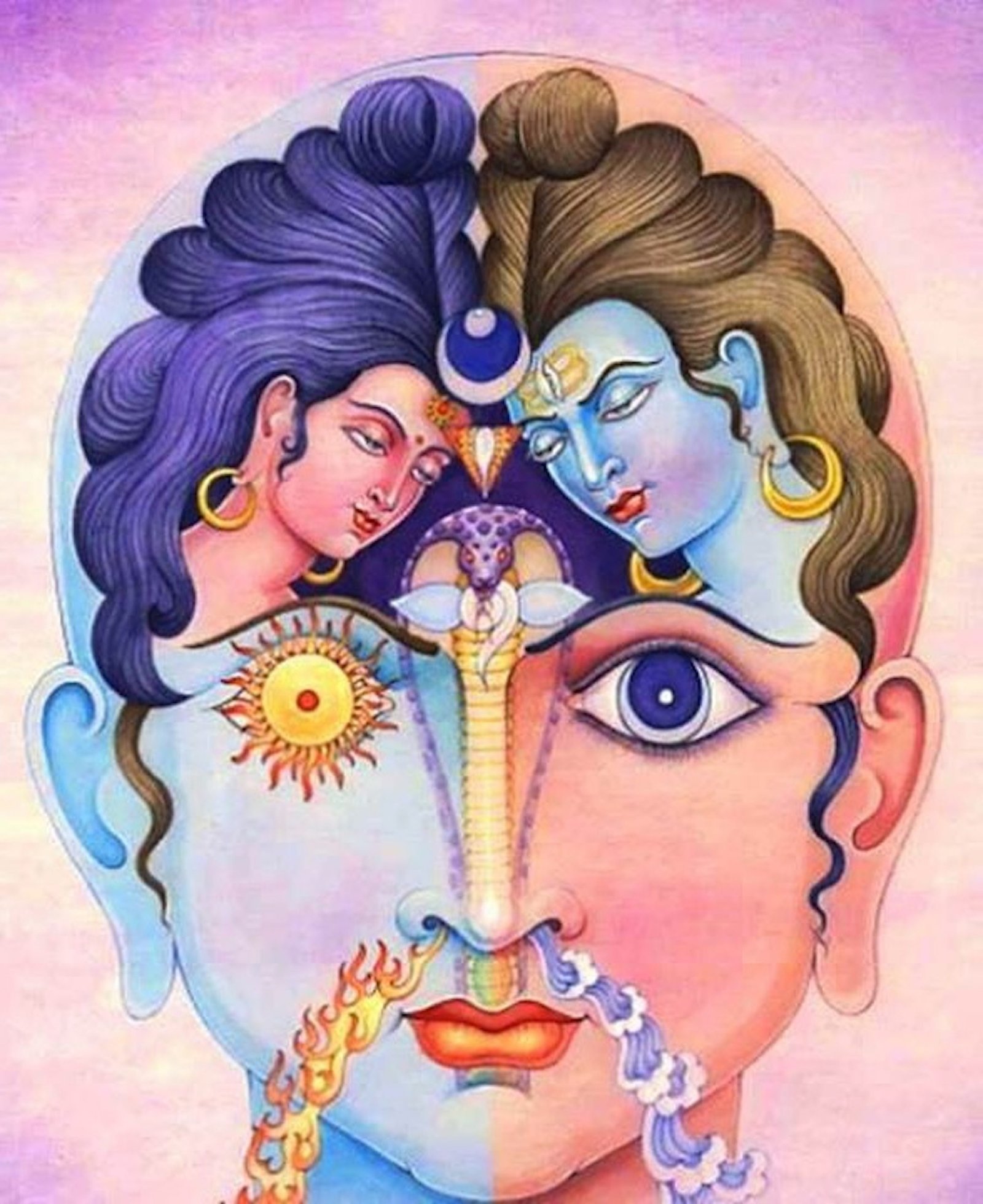
A traditional symbolic interpretation associates Ha with the sun and Tha with the moon: action and receptivity, firmness and adaptability, effort and rest. These are qualities we can all cultivate, regardless of sex or gender.
This balance is dynamic: practice teaches us when to sustain an action and when to reduce effort so we can perceive more clearly. Ida, Pingala and Sushumna offer a subtle map for contemplating this integration, without being literal equivalents of nerves, brain hemispheres or measurable electrical currents.
By learning to listen to the body, we expand our capacity to perceive, understand and respond.


The Trauma Response: A Cycle Between Body, Brain and Perception
A threatening experience can leave a lasting sensitivity to certain sensations, situations or memories. A sound, a place or an interaction can activate a protective response even when the original danger has passed.
This is not a lack of willpower. The body responds to what it interprets as a threat. Sometimes this response takes the form of agitation and hypervigilance; at other times, it appears as immobility, disconnection or difficulty feeling and acting.
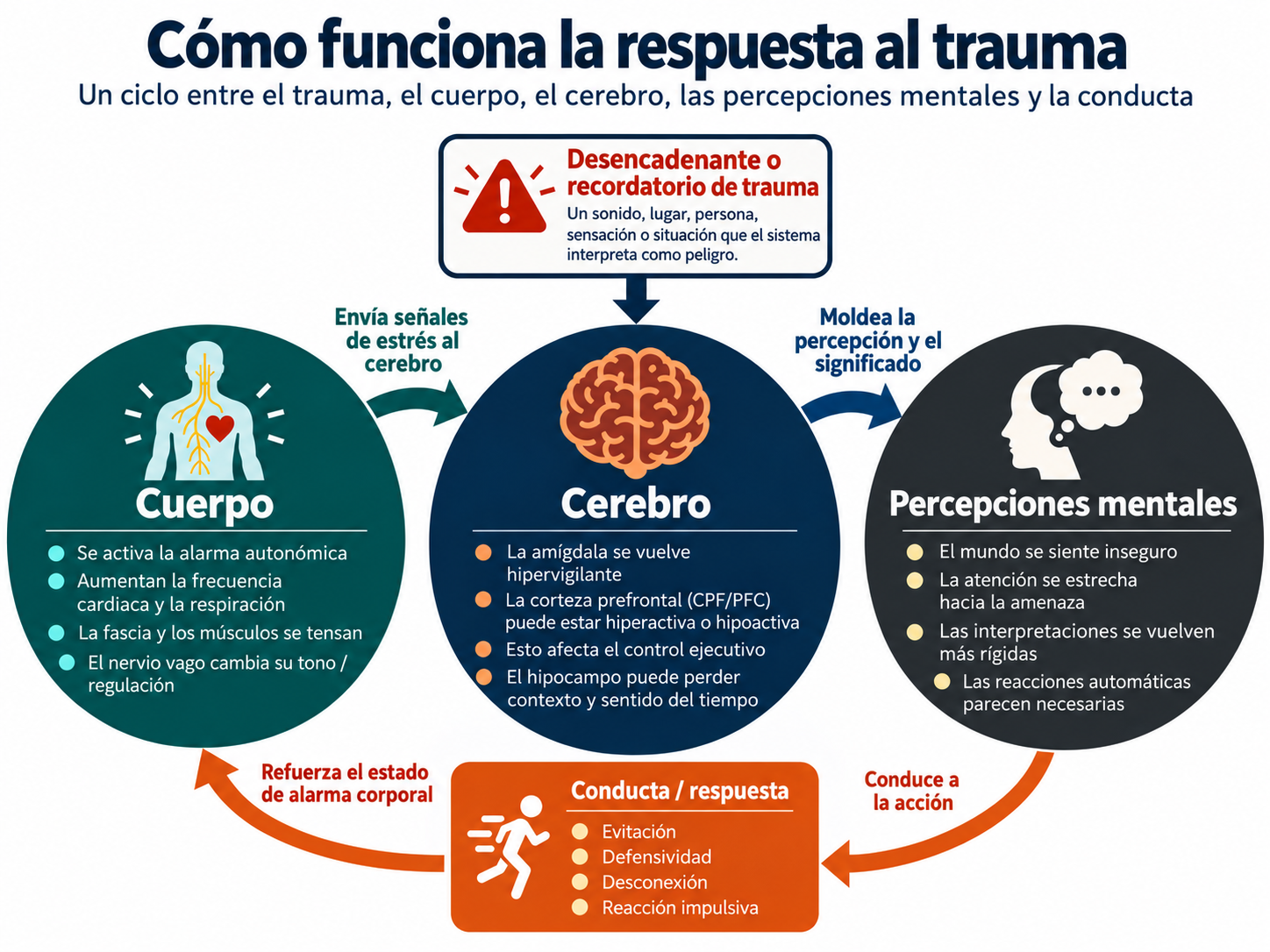
The trauma response can be understood as a cycle of interactions between bodily sensations, brain activity, interpretation and behavior.
How to Read This Cycle
- Body: breathing, heart rate and muscle tension may change. Internal sensations contribute to the experience of alarm.
- Brain: networks involved in threat detection, memory, context and response regulation play a role. The image highlights the amygdala, hippocampus and prefrontal cortex as parts of this broader system.
- Perception: attention may become focused on danger, and interpretations may become more rigid. An ambiguous situation can feel threatening.
- Behavior: avoidance, defensiveness or disconnection may offer immediate relief, but in certain circumstances they can also maintain the alarm cycle.
The diagram is a guide to understanding, not a fixed sequence that applies to everyone. Nor does it imply that the rational brain simply switches off. The response depends on context and coordination between different systems.
The Snake and the Branch: Learning to Update Our Perception
Imagine walking through the forest and seeing something that looks like a snake. Before you identify it clearly, your body may tense and prepare to move away. That reaction can protect you.
Looking more closely, you discover that it is a branch. Another equally important capacity now comes into play: taking in new information and allowing your response to change. If we keep reacting to the branch as though it were a snake, the initial prediction continues to shape our experience.
The practice of observation invites us to ask: am I responding to what is happening now, or to what I expect to happen? It is not about ignoring danger, but about perceiving more accurately when we need to protect ourselves and when we can regain space to choose.
From Contraction to Psychological Flexibility
The following image represents two experiences. On the left, persistent threat progressively narrows attention and perceived possibilities. On the right, an opening toward greater body awareness, choice and participation in one’s own life is represented.
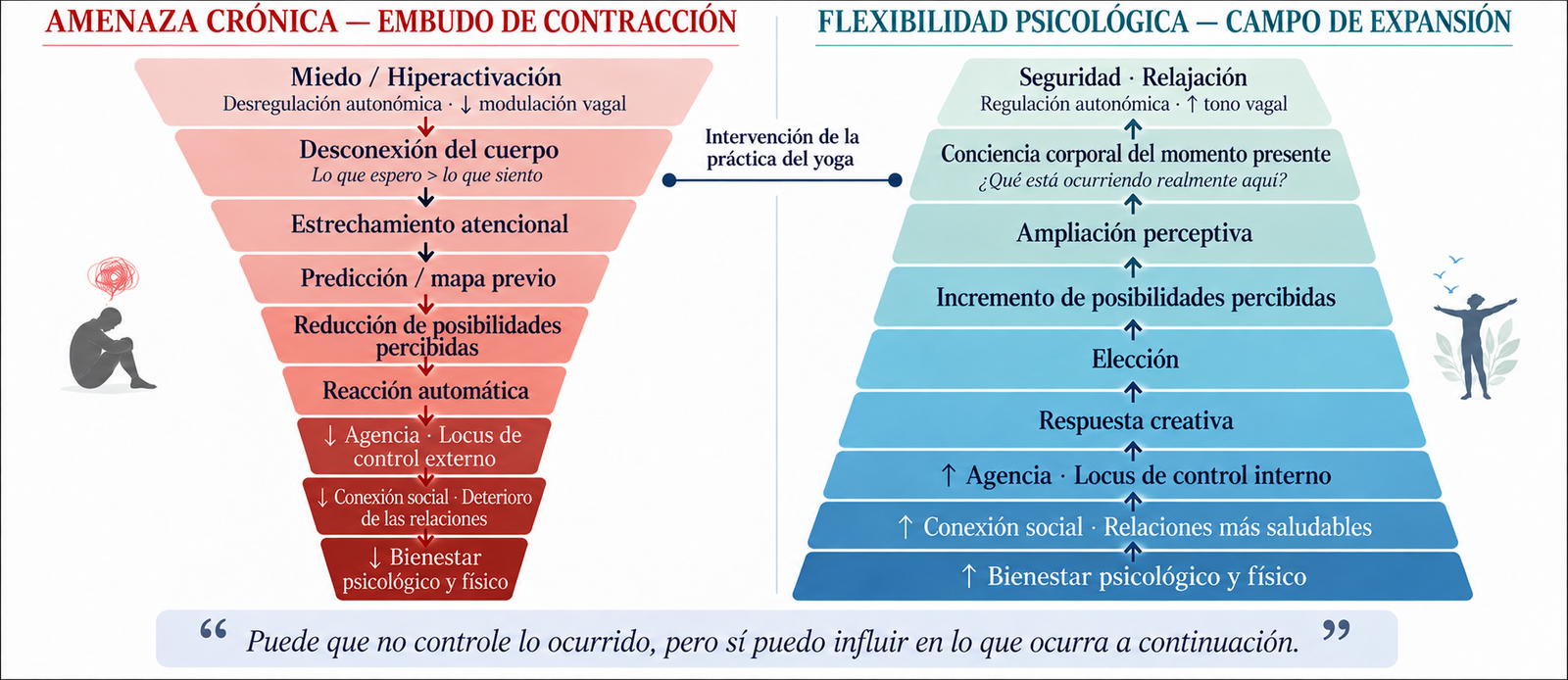
In the red funnel, fear and bodily disconnection leave progressively less room to perceive alternatives. Prior expectations may carry more weight than present information. The automatic reaction eventually feels like the only possible response.
The blue and green field presents another possibility: recognizing sensations, finding support and expanding what we can observe. This openness allows us to consider more than one response, establish boundaries, ask for help or act differently.
Psychological flexibility is the ability to adapt our response to the situation, even when difficult emotions are present. Safety, perception and relationships influence one another; the process does not have to follow a rigid order or always move in a straight line.
References to vagal tone and autonomic regulation belong to the figure’s explanatory framework. They should not be interpreted as measurements of a person’s state based on their posture or how they appear to feel.
Locus of Control: Regaining a Sense of Agency
Locus of control describes how we perceive our influence over what happens in our lives. A predominantly external orientation may be expressed as “nothing I do will change things.” An internal orientation recognizes that our actions can make a difference, even though they do not determine every outcome.
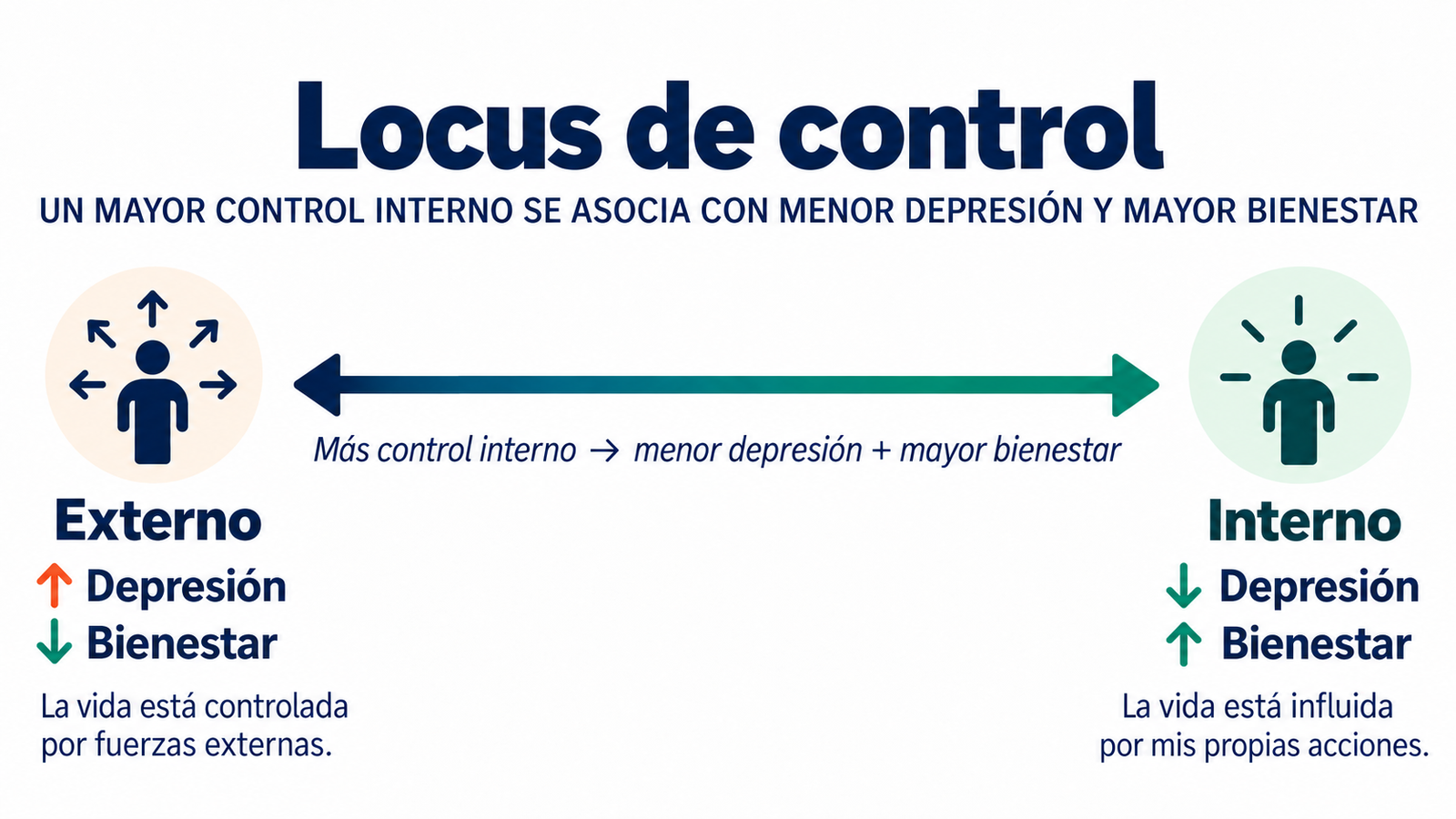
Regaining agency means recognizing real possibilities for action: changing a point of support, taking a pause, expressing a need or seeking guidance. It also means distinguishing between what we can influence and circumstances that require external support or changes in our environment.
We are not responsible for having experienced trauma. Practice can become a space to explore making our own choices, without demanding that we control every sensation or work through our history alone.
“I may not control what happened, but I can influence what happens next.”
Each Asana: A Space to Observe, Adjust and Choose
In a posture, we can explore concrete questions: where do I feel supported? Can I breathe without forcing? Am I using more effort than necessary? What changes when I adjust my position?
Observation becomes valuable when we can respond to what we discover. Adjusting the posture, using a prop or resting are choices that form part of the practice. The ability to choose matters as much as the outward form of the asana.
For some people, turning attention inward may feel uncomfortable or overwhelming. We can begin with more accessible sources of support: looking around the space, feeling the contact of the feet or making a simple movement. The practice adapts to the person and can accompany a therapeutic process when needed.
A Stable Body and a Flexible Mind
Stability requires the ability to adapt. In the body, we explore strength and mobility; in the mind, attention and openness. An overly rigid structure limits movement, while a lack of support makes movement difficult to sustain.
This relationship runs through the
foundations of Yoga Asana:
learning to support ourselves without becoming rigid, and to move without losing our foundation.


Karmuka Yoga: Observing Through the Body to Broaden Our Response
Karmuka means bow: a structure whose stability arises from the balance between complementary forces. This principle guides our practice: developing support without rigidity, mobility without losing stability, and attention without losing sight of the whole.
We integrate neuroscience, psychology and somatic education with tools for awareness and support from Iyengar Yoga, Critical Alignment, Yamuna Body Rolling and Somatic Experiencing. Props, alignment, movement and breathing help students observe their patterns, explore alternatives and understand the relationship between body, brain and mind through their own experience.
The mat becomes a laboratory for self-knowledge. We learn to recognize tension, adjust our effort and respond with greater awareness.
This brings us back to where we began: the work of Yoga Asana has very little to do with achieving a posture and everything to do with expanding our capacity to perceive and choose.
This search for freedom is the essence of yoga. Hatha Yoga offers us a path to cultivate it through awareness of the body and breath, carrying what we learn far beyond the yoga mat.
Yoga Classes and Courses in San Luis Potosí and Online
Explore this approach in Karmuka Yoga’s classes and courses in San Luis Potosí and online. You can also deepen your practice through our workshops and retreats, or discover our yoga teacher training in San Luis Potosí.