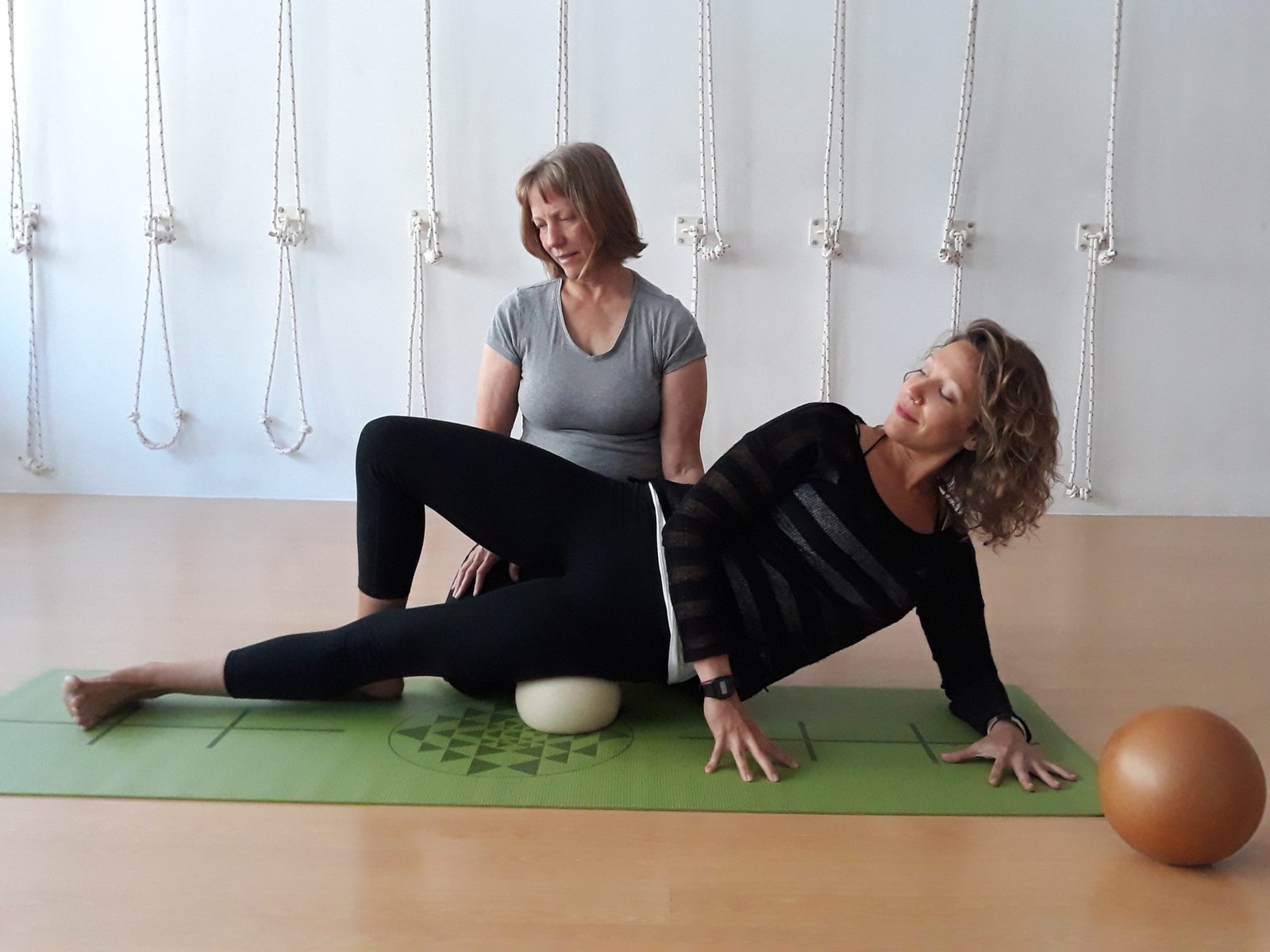
Karmuka Yoga · Yoga Philosophy
The Yoga the Market
Doesn’t Want You to Know About
What does it mean to practise yoga beyond the postures? This reflection explores yoga philosophy, the five koshas and Patanjali’s eight limbs: an invitation to connect physical practice with breathing, attention and self-knowledge.
Right now, you are being sold a version of yoga. It comes in many flavours: hot yoga, yoga for trauma, core yoga, yoga for anxiety, yoga with blocks, yoga for weight loss, rope yoga, goat yoga, yoga for better sleep. The marketing is good. The packaging is beautiful. The person on the cover looks incredible.
But this version of yoga has a problem: it is missing almost everything that makes yoga yoga.
Attention, Perception and the Yoga Market
Iain McGilchrist proposes a way of understanding two modes of attention: one that emphasises context and relationships, and another that analyses, categorises and separates. In this article, his proposal serves as a starting point for reflecting on how we perceive and consume yoga. It is an interpretive perspective: it does not mean that each hemisphere functions in isolation or that we can identify a yogic experience with a single region of the brain.
The attention economy encourages distraction and the constant pursuit of novelty. We scroll, click and buy: there is always something new promising a solution. In the yoga market, a new style, teacher or retreat can create a sense of progress without requiring what is sometimes more difficult: remaining quiet long enough to look within.
Marketing can reinforce this fragmented perspective. A yoga industry built around products and trends risks taking an integrated practice and dividing it into marketable pieces.
When we lose context and relationship, seeing only parts rather than wholes, we can recognise an analogy with what the yogic tradition calls Maya, the illusion of separation. This is a philosophical connection, not a demonstrated equivalence between a traditional concept and a cerebral hemisphere.
The Five Koshas and the Eight Limbs of Yoga
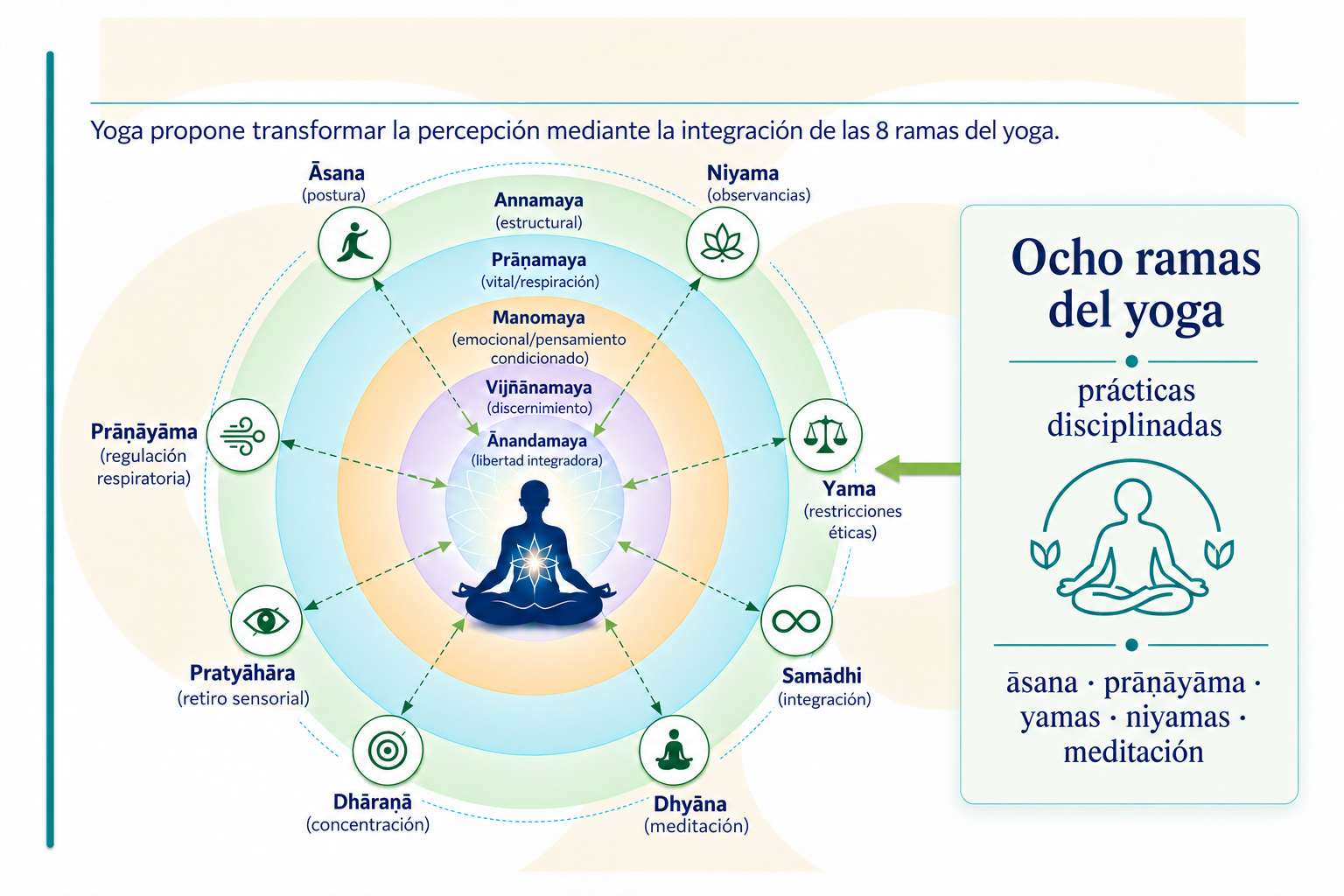
The classical yoga tradition does not treat the body as something separate to be toned, stretched or fixed. It understands the human being as existing within five layers of experience, known as the Pancha Koshas:
To work with the whole person, yoga offers eight limbs of practice: Patanjali’s Ashtanga, the complete path.
01 · Yamas
Ethics in our relationships with others: non-harming, truthfulness, non-stealing, integrity and non-grasping.
02 · Niyamas
Ethics in our relationship with ourselves: cleanliness, contentment, discipline, self-study and surrender.
03 · Asana
Physical posture and movement.
04 · Pranayama
Regulation and expansion of the breath.
05 · Pratyahara
Withdrawal of the senses, directing attention inward.
06 · Dharana
Single-pointed concentration.
07 · Dhyana
Continuous meditation, sustained awareness.
08 · Samadhi
Absorption, union: the dissolution of the sense of separation.
Much of what our modern world calls yoga does not begin with the first limb. It jumps straight into Asana, skipping the Yamas and Niyamas: the ethical foundation that gives integrity and direction to the entire practice. Without this root system, even the physical practice is left unanchored. The limbs that follow, breathing, attention, meditation and union, are barely mentioned.
The result is a structure built from the middle upwards, without roots below or reaching its full height. Without integrating the other seven limbs, the practice never develops the stability needed to sustain real transformation or the depth to access actual states of expanded awareness. What remains is a hollow spirituality: aesthetically convincing, yet lacking stability, healing or meaningful direction.
It uses Asana, which in the classical tradition is a means of deepening perception and preparing the body and nervous system for subtler practices, as an end in itself. Physical form becomes the goal: the perfect posture, the flexible body, the aesthetic achievement.
But Asana practised this way points to itself rather than through itself, meaning that the journey yoga was designed for never truly begins.
A practice that addresses only the physical layer is like eating a food labelled healthy that turns out to be full of sugar and empty calories. It looks good. It sells well. But it does not nourish you, and in the long term it may even cause harm.
Alignment, Breathing and Attention in Practice
Here is what changes when Asana is practised within the full context of the other limbs:
As you move into a posture, you withdraw your attention from external noise (pratyahara) and direct it towards something specific, such as the architecture of the foot (dharana). You follow that detail upwards through the ankle, knee, hip, spine and skull, expanding into whole-body awareness (dhyana).
You observe how a harmful pattern in one part affects the whole, and how the whole, in turn, can alter and change that part. Perception shifts from a one-way account of cause and effect to something reciprocal: reality as relationship rather than separation.
This is why skeletal alignment matters: not as an aesthetic achievement, but because the way the bones stack affects the movement of the breath (pranayama), and the breath directly affects the mind.
Alignment is the instrument.
Expanded awareness is the music.
Neither is more important than the other. That approach reflects the hierarchical thinking of the left hemisphere, always needing to rank what is, in fact, interwoven. Without a well-tuned instrument, there is no music, and without the music, there is no reason to pick up the instrument.
From this perspective on practice, the noise may settle and attention may shift away from focusing exclusively on the external shape of the posture. The experience becomes an opportunity to listen to what is happening in the body and observe our relationship with our surroundings.
In the language of the yogic tradition, Samadhi points towards an experience of absorption or union; it is not presented here as a clinical outcome or as the verified activation of a particular hemisphere.
This approach invites us to explore the habits and conditions that influence our experience, rather than seeking only a quick fix. Its meaning in this article is philosophical and experiential; it does not constitute a promise of a cure.

Why Ethics Is Part of Yoga
The Yamas and Niyamas do not sell well. Ethics rarely does, especially in a world so oriented towards the market and individualism. Yet they are the foundation on which everything else is built, both personally and collectively.
Crucially, they are not abstract moral codes to agree with intellectually and then ignore. They are practices: trained on the mat, embodied in the body and carried into life.
Consider Satya, the practice of truthfulness, and Tapas, the discipline of consistent action. On the mat, every time you remain present with discomfort instead of leaving a posture, every time you modify a posture instead of forcing an external shape your body is not ready for, quieting the ego and being honest about where you truly are so that the inner message can be heard, you are training Satya and Tapas at a somatic level.
Over time, this training creates a new baseline. Coherence, the alignment of thought, word and action, stops being an aspiration and becomes a lived sensation. Its absence is felt just as clearly.
Someone who has done this work long enough discovers that lying, whether to themselves or others, or making a promise they have no intention of keeping, produces immediate discomfort in both mind and body. Cognitive dissonance is no longer abstract. It registers physically. The lie becomes more uncomfortable than the truth it was meant to avoid.
This is Asana as a training ground for life: not a performance, but a laboratory for developing into someone whose word carries weight because their inner and outer worlds truly align.
Someone who never does this work, who speaks beautiful words but follows through on nothing, who says yes when they mean no and confuses comfort with wisdom, has little real power over their inner world and therefore little meaningful influence on the world around them.
They remain captive to their own evasions, circling through the same patterns, wondering why nothing changes. True freedom, Samadhi in its deepest sense, is not a destination we reach.
It is built word by word, promise by promise, through the daily, unglamorous practice of becoming someone whose inner and outer worlds align. That coherence is the source of real power because the universe listens and responds accordingly.
Yoga as Revolution: From Reflection to Practice
Real transformation through yoga requires less money, less marketing and significantly more discipline than the industry would have you believe. It is not a quick fix. It is not always comfortable. And there are no shortcuts.
What it offers instead is this: a path from scattered to centred, from fragmented to whole, from victim to co-creator. A way of training perception so that you stop seeing isolated problems to manage and begin experiencing an interconnected life to live fully.
This is neither a luxury nor a lifestyle choice. It is, without doubt, the most urgent work of our time. We are saturated with news cycles documenting endless wars, institutional corruption and systemic violence: a sickness that originates at the top and filters down, shaping the values, nervous systems and relationships of entire societies.
It is easy to feel powerless in the face of it. Easy to place the problem above us, waiting for those who created it to solve it.
But conscious revolution has never worked that way. Every real change in human history began not in parliaments or boardrooms, but within individual human beings who did the work of awakening, whose clarity, coherence and refusal to remain unconscious created a ripple others could feel.
Someone who has truly transformed their perception, who responds instead of reacting, who lives in coherence rather than contradiction, changes more than their own life. They change the lives of everyone they touch. And those people change others.
A single candle in a dark room does not illuminate everything, but it makes it possible to light the next, and the next. This is how consciousness evolves. Not from the top down. From the inside out.
Yoga does not calm the mind so that you can spiritually bypass your discomfort or turn away from the state of the world. It calms the mind so that you can finally face what is there, within you and around you, and respond to it.
That is the meaning of response-ability. That is where the real revolution begins. And it begins with you, on the mat, facing the truth of who you really are.
In the kosha model, practice invites us to observe different dimensions of experience: the physical body (Annamaya), breath and vital energy (Pranamaya), mental and emotional life (Manomaya), discernment (Vijnanamaya) and bliss or wholeness (Anandamaya). These are concepts from the yoga tradition, not anatomical layers or a classification of brain functions.
What changes when we begin to perceive our possibilities differently?
The image of an open door invites this question. In the yogic tradition, Maya and Samadhi offer a language for exploring separation, connection and inner freedom. That reflection can begin on the mat and continue in everyday life.
KARMUKA YOGA
San Luis Potosí · Online · Worldwide
Bring Yoga Philosophy into Your Practice
Explore Karmuka Yoga’s practice and teaching in San Luis Potosí and online, as well as our workshops and retreats around the world.
Explore Yoga Classes in San Luis Potosí
Deepen Your Understanding of Yoga Therapy
Discover Karmuka Yoga’s 100-hour training programme, developed by Dr. Michelle Goodrick. It integrates functional anatomy, yoga philosophy, psychology and neuroscience, with in-person practice, case studies and personalised guidance.